Signal Theory of Intelligence
for the European Union’s Human Brain Project
12 Theorems of the theory
12.1 Theorem 1 — Signal completion as an arithmetic necessity
A two-layer linear system with rank-1 operators necessarily completes missing signal components.
Justification: Each intermediate neuron realises a dyadic product
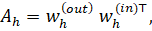
and the overall mapping is a projection that maps
incomplete input signals onto a complete signal space. This results in
elementary signals in the output layer that were missing from or obscured by
noise in the input signal.
is a projection that maps
incomplete input signals onto a complete signal space. This results in
elementary signals in the output layer that were missing from or obscured by
noise in the input signal.
This is a creative act that occurs without learning.
12.2 Theorem 2 — Non-linearity according to the inverse system generates states
A non-linearity applied to the reconstructed elementary signals of the inverse system generates discrete states and categories in the signal space.
12.3 Theorem 3 — Recursion generates internal models and thought
A recursive system that combines signal completion and non-linearity generates internal models and begins to think.
Justification: The recursive mapping

leads to a cyclical alternation between elementary and complex forms. This cycle stabilises patterns, supplements missing signals, generates hypotheses and forms internal models. Thus, thinking emerges as an emergent property of recursive signal processing.
12.4 Theorem 4 — Learning shapes the attractors and adapts the system to the world
Hebb and anti-Hebb mechanisms, LTP, LTD and normalisation shape the attractors of the recursive system so that they reflect the structure of the external world.
Justification: Learning is not
necessary for signal completion or thinking, but it is necessary to adapt the
internal models to real environmental structures. Learning shapes the weight
matrix
 in such a way that the attractors
stabilised by recursion become meaningful.
in such a way that the attractors
stabilised by recursion become meaningful.
12.5 Summary of the four propositions
1. Signal completion arises automatically through rank-1 operators.
2. Non-linearity generates categories and states.
3. Recursion generates internal models and thought.
4. Learning makes these models world-adapted.
These four propositions form the minimal arithmetic theory of thought.